
Vietnamese Tea Ceremony in Nha Trang: 5 Steps Explained
A Vietnamese tea ceremony is the family ritual in which two families meet, the ancestors are told the news, and the couple serves tea to the elders who will now call them husband and wife. If you grew up abroad with parents who never explained it, this guide is for you. It covers what happens, in what order, what to wear and what it costs in Nha Trang.
You do not need to speak Vietnamese to take part. Jolie Mai Wedding & Events speaks English with you and Vietnamese with your parents, so each step is explained to you in your language while the elders hear theirs. The words in this guide are given in Vietnamese so that you recognise them when your family says them.
[rank_math_toc]
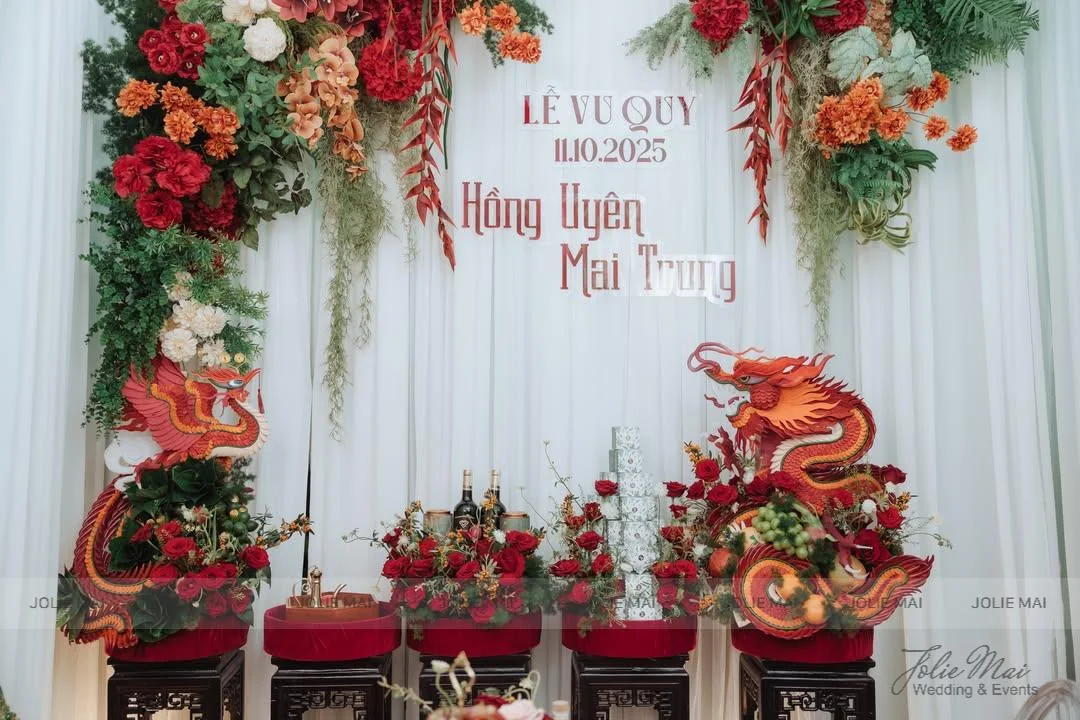
What is a Vietnamese tea ceremony?
The Vietnamese tea ceremony is not one event with one fixed name. It is a family gathering built from several traditional rites. Which rites the family holds, and what they call them, depends on the region, the age of the elders and the choices of the two families.
Four Vietnamese terms cover most of what you will hear. They are easier to follow once you see how they fit together.
| Vietnamese term | Plain English | What it means in a Vietnamese tea ceremony |
|---|---|---|
| Lễ ăn hỏi | Engagement ceremony | The groom’s family brings gifts on covered trays to the bride’s home and asks formally for the marriage |
| Lễ gia tiên | Ancestor rite | The couple lights incense before the family altar to tell the ancestors and ask for their blessing |
| Lễ vu quy | Bride’s farewell ceremony | The ceremony at the bride’s family home when she leaves to join her husband’s family |
| Lễ rước dâu | Bride procession | The groom’s party arrives to escort the bride to his family’s home |
Sources differ on where each rite sits. Some place the tea on the engagement day, others on the wedding morning, and some families combine everything into one morning. Vietnam’s national tourism site, for example, describes the engagement ceremony as the stage where gifts are carried in on trays and the couple prays before the bride’s family altar. Travel guides add the tea itself to the same day.
The practical answer is to ask your parents which rites they expect. Most families have a clear picture in their heads even when they have never written it down. Bring that picture to the planning, and the rest can be organised around it.
Why tea, and why the elders drink first
Tea is the way a couple says thank you and asks for acceptance. According to a Vietnamese tea ceremony guide, the couple pours tea into small cups and serves family members, starting with the eldest, such as grandparents and parents from both sides. Relatives then give gifts and advice for the marriage.
That order is the point. When an elder accepts the cup, the family is saying, in front of everyone, that the couple has their approval. For parents who stayed in Vietnam while their children grew up abroad, this is often the part they have waited years to see.
Is a Vietnamese tea ceremony a legal wedding?
No. It is a cultural and family ceremony. Registering a marriage is a separate process with its own paperwork, and the requirements depend on your citizenship. Jolie Mai organises the ceremony and the decoration. It does not handle legal procedures.
For the paperwork side, read our overview of getting married in Vietnam, and confirm the current rules with your embassy or the local Department of Justice before you book flights.
The Vietnamese tea ceremony in five steps
The order below is the most common shape of a Vietnamese tea ceremony held at the bride’s family home. Families adjust the Vietnamese tea ceremony, and your parents have the final word. Use it as a map, so that nothing on the day comes as a surprise.
Step 1: The welcome at the gate
The groom’s family arrives, usually in matching áo dài, and waits at the gate or door. Someone from the bride’s side welcomes them in. A representative of the groom’s family asks permission to come in and to present the gifts.
For a couple from abroad, this is a good moment to stand with your parents and watch. The words are formal, a little theatrical and often funny. If you do not follow them, a bilingual host can whisper the meaning.
Step 2: The trays are carried in
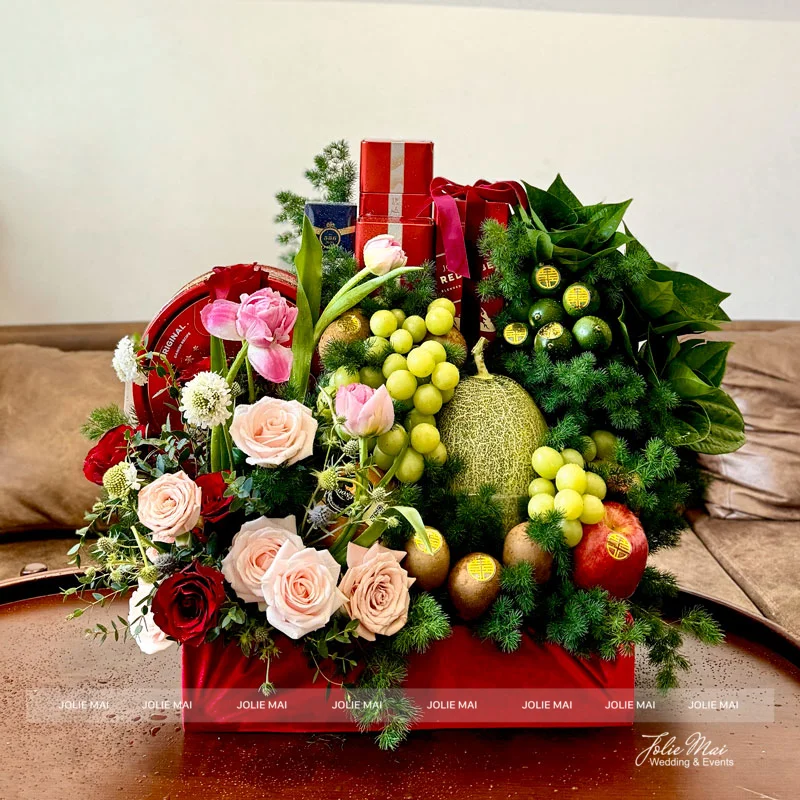
At every Vietnamese tea ceremony the next arrival is the gift trays, called mâm quả in the South and tráp in the North. They are covered in red cloth and carried in by young unmarried relatives. The Vietnam tourism source puts the number of bearers at 5, 7 or 9, young men for the groom’s side and young women to receive the gifts for the bride’s family.
Typical contents are betel leaf and areca nut, wine, tea, husband-and-wife cake (bánh phu thê), sticky rice and sometimes a roast pig. Each item carries a wish: fidelity, sweetness, a full house. We return to the trays in a section of their own below.
Step 3: Offering incense at the family altar
Once the gifts are placed, the couple stands before the bride’s family altar, lights incense and bows. This is the lễ gia tiên. It tells the ancestors who the groom is and asks for their blessing on the marriage.
In many homes the altar is the visual heart of the whole morning. It is also the part Jolie Mai decorates: the backdrop, the long table for the two families, the flowers, the welcome sign and the red and gold details that frame the photographs.

Step 4: Serving tea to the elders in the Vietnamese tea ceremony
This is the moment that gives the Vietnamese tea ceremony its name. The couple serves tea to the grandparents first, then the parents of both sides, then uncles, aunts and older siblings. After each cup, the elder may say a few words, give a gift or offer advice.
If you are the bride or groom, expect to bow slightly and hold the cup with both hands as a sign of respect. If you are the partner of a Vietnamese person and do not know Vietnamese, you will not be expected to give a speech. A short phrase and a sincere bow are enough, and a planner can teach you the phrase beforehand.

Step 5: Photographs, a shared meal and return gifts at the Vietnamese tea ceremony
After the tea, the families take group photographs in front of the altar backdrop. A meal follows, often a family lunch. At the end, the bride’s family traditionally sends part of the gifts back to the groom’s family, a custom that expresses balance between the two sides.
Some families end the Vietnamese tea ceremony and move straight on to a reception or a second ceremony. Others stop here and keep the wedding party for another day. For overseas Vietnamese couples with limited holiday time, the combined morning and afternoon pattern in the next sections is a practical choice.
Vietnamese tea ceremony timeline: a typical day in Nha Trang
Families choose the date and hour in different ways. Some ask an elder to pick an auspicious time, others simply follow the venue and the guests’ flights. The schedule below is a typical Vietnamese tea ceremony timeline for a family ceremony at home or in a villa, followed by a vow ceremony by the sea. The hours are typical examples only. The real times are set by your families.
| Typical time | What usually happens | Who is involved |
|---|---|---|
| Early morning | Family gathers at the bride’s home, altar and tables are checked, flowers are in place | Bride’s family, decorators |
| Morning, around the chosen hour | Groom’s family arrives, trays are carried in, representatives speak | Both families |
| Shortly after | Couple lights incense at the altar | Couple, elders |
| Next | Tea is served to the elders, gifts and advice are exchanged | Couple, all elders |
| Late morning | Group photographs at the altar backdrop | Both families, photographer |
| Midday | Family lunch at home or at a restaurant | Both families |
| Afternoon | Rest, change of clothes, travel to the beach | Couple, close family |
| Late afternoon | Optional vow ceremony by the sea | Couple, guests |
The traditional rites are only part of the morning. The rest is photographs, greetings and food. Build in more time than seems necessary, because a family gathering of this kind rarely runs to the minute.
What can go wrong with the Vietnamese tea ceremony timeline
Three things usually move the schedule: traffic, the weather and the number of relatives who each want a photo. Plan a buffer before the groom’s family is expected, and tell the elders the real arrival time instead of an optimistic one.
If the ceremony is outdoors, the afternoon sun matters. Your planner will check where the shade falls at the hour you have chosen, and may suggest a canopy or moving the altar to a covered terrace.
What to wear to a Vietnamese tea ceremony
The traditional answer is the áo dài, the long fitted tunic worn over trousers. Both families usually coordinate colours so that the photographs look unified. The bride often wears a more detailed áo dài, sometimes with the khăn đóng, a round headdress. According to the same Vietnamese tea ceremony guide, the áo dài is worn by both bride and groom and the bride’s outfit is more elaborate than her bridesmaids’ or the groom’s.
For the groom, a matching áo dài with a khăn đóng is the traditional choice. Many modern grooms wear a suit instead, and in the Vietnam tourism description men wear either an áo dài or a suit.
What to wear to a Vietnamese tea ceremony as a guest
Guests at a Vietnamese tea ceremony who are not family can wear modest, smart clothing. Shoulders and knees covered is a safe rule in front of elders and an altar. Colours in red, gold, pink and ivory suit the occasion. If you are unsure about a colour, ask your parents.
What to wear to a Vietnamese tea ceremony if your partner is not Vietnamese
A partner from another background can choose between a suit, a smart outfit in a coordinated colour, or a borrowed áo dài for men. A tailor can make an áo dài to measure, but fabric and fitting take time, so order early. Your families will be touched by the effort even if the cut is not perfect.
Whatever you choose for the Vietnamese tea ceremony, decide it with the families early. The colours should work with the altar flowers, the tray cloths and each other.

Trays, flowers and the altar: what the decoration includes
A Vietnamese tea ceremony relies on three decorated elements: the altar and backdrop, the trays, and the table where the families sit. Jolie Mai has decorated these for the Vietnamese tea ceremony in Nha Trang for twelve years, so the section below describes how the work is divided.
The altar, backdrop and family table
The altar backdrop is the frame for every photograph of the morning. Jolie Mai builds it with a firm panel from about 2.8 to 4.5 metres wide, a table for the two families, a flower gate, a welcome board, grass carpet, and tea, water, chairs and table linen chosen to match the concept. These are the items listed in the price book for the Diamond package.
Diamond is made entirely of silk flowers. The advantage is that the set can be built the same way every time, it does not wilt in a hot room, and the budget is clear in advance. The page for gia tiên decoration in Nha Trang shows real sets in red, cream, peach and green tones.

Fresh flowers for a Vietnamese tea ceremony
Some families prefer fresh flowers for the Vietnamese tea ceremony, which smell better and photograph with more depth. A fresh-flower set is designed to your concept, with the price starting higher. Fresh flowers are ordered shortly before the ceremony and arranged last, so they stay fresh until the tea is served.
One example: in January 2026, a family villa by the Tac River in Nha Trang held a fresh-flower tea ceremony. Ten people built the frame, and five more arranged the flowers. The family chose not to share the cost, so no figure appears here, but the numbers show that a fresh set is real construction work, not just a bouquet.

Trays for the Vietnamese tea ceremony (mâm quả)
Trays are the visible gift of the groom’s family at a Vietnamese tea ceremony. Jolie Mai arranges them in the style each family asks for. The Vietnamese tea ceremony traditions differ by region, and a mixed family can hold two traditions at once.
Here is what the family usually expects:
- Northern custom: the trays are called tráp, with a lid, and the number is odd: 5, 7, 9 or 11.
- Southern custom: the trays are called mâm quả, carried uncovered, and the number is even: 4, 6, 8 or 10, because gifts go in pairs.
- Central Vietnam and Khánh Hòa: the number is flexible, usually 5 to 7, and elders care more about completeness than quantity.
The odd-number rule for the North is confirmed by the Vietnam tourism source above: the number must be odd, such as 5, 7 or 9. The even-number custom in the South comes from Jolie Mai’s own experience of local families and varies between sources, so confirm with your parents before ordering.
If the two families come from different regions, the rule Jolie Mai follows is simple. The number of trays and main items follow the bride’s family. The groom’s side adds anything from its own region that it wants to bring. Nothing from either side is left out.

How Jolie Mai works with a family that speaks two languages
The hardest part of a Vietnamese tea ceremony for overseas families is rarely the flowers. It is the conversation. Parents in Nha Trang think in Vietnamese customs. Their children think in English schedules and photo plans. Someone has to carry meaning in both directions.
For a Vietnamese tea ceremony, Jolie Mai talks with you in English by WhatsApp or Zalo, and with your parents in Vietnamese by phone, in person or on Zalo. When your mother says the altar must face a certain direction, or your aunt wants a roast pig on the second tray, the instruction is written down and translated, then shown to you before anything is built.
For a Vietnamese tea ceremony planned from abroad, this means three things in practice:
- You see the design plan in English and approve it before construction.
- Your parents hear the same plan in Vietnamese and can correct anything that goes against family custom.
- Any change after approval is recorded in writing, so nobody argues from memory later.
On the day, the Jolie Mai team keeps the decor and the order of the trays on track. If you do not speak Vietnamese, Jolie Mai can provide an English-speaking host who stands with you and explains each step as the elders speak. The host is booked as a separate service and quoted when you book.
Vietnamese tea ceremony cost in Nha Trang
The Vietnamese tea ceremony cost has two parts. The first is what you pay Jolie Mai: the altar decoration and the trays. The second is everything the family pays for separately: food, áo dài, photographer, the contents of the trays and any venue fees. Only the first part is priced on this page.
All prices below are from the Jolie Mai 2025–2026 price list, approved in September 2026. They are anchor prices for central Nha Trang under standard conditions. Venues in other districts may add a separate line item, written in your quote.
Vietnamese tea ceremony cost: altar decoration
| Item | Price (VND) | What it includes |
|---|---|---|
| Diamond ancestral altar, silk flowers | 9,800,000 | Firm backdrop 2.8 to 4.5 m, two-family table, silk flower gate, welcome board, grass carpet, tea, water, chairs and table linen to match the concept |
| Luxury altar, silk flowers with fresh leaves | 11,800,000 | As Diamond, with fresh foliage; no canopy included |
| Fresh-flower altar | from 15,000,000 | Designed to your concept |
| Flower gate for a 5 m wide house front | 10,000,000 | Silk flowers with some fresh leaves, made to a sample |
Vietnamese tea ceremony cost: trays
| Item | Price (VND) | What it includes |
|---|---|---|
| Betrothal asking tray set (dạm ngõ) | 2,500,000 | Trays for the first, smaller visit |
| Traditional set | 4,700,000 | 5 trays |
| Dragon and phoenix set | 4,700,000 | 5 trays with dragon and phoenix decoration |
| Prosperity set (Phú Quý) | 6,000,000 | 5 trays |
| Premium set (Phụng Hỷ) | 9,000,000 | A higher-end set |
| Sixth tray, fruit | 800,000 | Added to a set |
| Dragon and phoenix candles | 150,000 | Added to a set |
A tray team to carry the gifts is quoted by the number of people. If your family needs a different number of trays, such as 7 or 9, Jolie Mai builds that number and the price per tray is written in the quote.
An example budget for the Jolie Mai part
A couple who wants the Diamond altar and a traditional set of five trays would pay VND 9,800,000 plus VND 4,700,000, which is VND 14,500,000. This does not include the food, the clothing or the photography, and it does not include the beach ceremony in the next section.
To hold your date, Jolie Mai asks for a VND 5,000,000 deposit. Later instalments are stated in your quote and contract. The date is held once the deposit is received.
For wedding budgets beyond the tea ceremony, see Nha Trang wedding cost, which sets out decoration, flowers and coordination line by line.
The ceremony tray details families ask about
Overseas couples planning a Vietnamese tea ceremony tend to ask the same questions about trays. The answers are short, but they save an argument at dinner.
Who pays for the trays?
Traditionally the groom’s family prepares and pays for the gifts, and the bride’s family hosts the ceremony. Modern families often split these costs or let the couple pay. Agree this early, because it changes who orders what.
Who carries the trays?
Young unmarried relatives, according to the Vietnam tourism description. If your cousins are abroad, Jolie Mai can quote a tray-bearing team, priced by the number of people.
What if my family wants fewer trays?
The number is a matter of means and local custom. A smaller set is acceptable if both families agree. Five trays is the number most families in Khánh Hòa ask for.
For prices and photographs of tray styles, see Jolie Mai’s page on wedding trays and mâm quả in Nha Trang.
Morning tea ceremony, afternoon beach vow: a combined day in Nha Trang
Some couples coming home want both things: the family ritual their parents expect and the beach ceremony they imagined. The Vietnamese tea ceremony and the vow sit well together because they happen at different times of day and need different light.
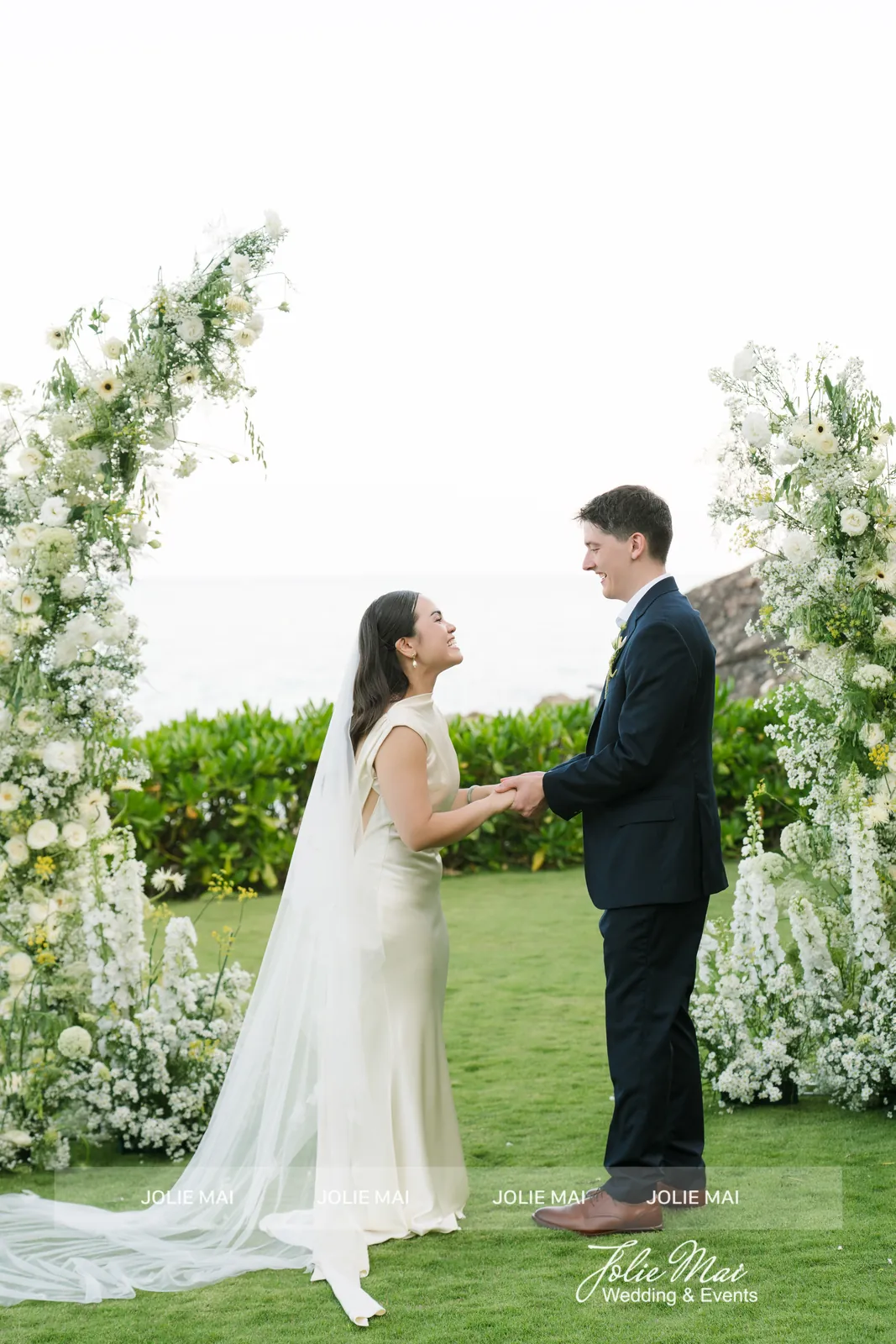
The morning belongs to the family. The altar is warm, red and gold, and the room is full of elders. By afternoon the couple can change clothes, drive to the coast and stand under a flower arch for a short vow ceremony with a smaller group.
This is an idea, not a package, and the details depend on the venue and the season. Generally the best months for beach ceremonies in Nha Trang run from January to August. The public Tran Phu beach cannot be decorated by Jolie Mai, so a beach ceremony takes place on the private beach or deck of a resort, or on a venue such as Vega City or Amiana.
What the beach vow looks like
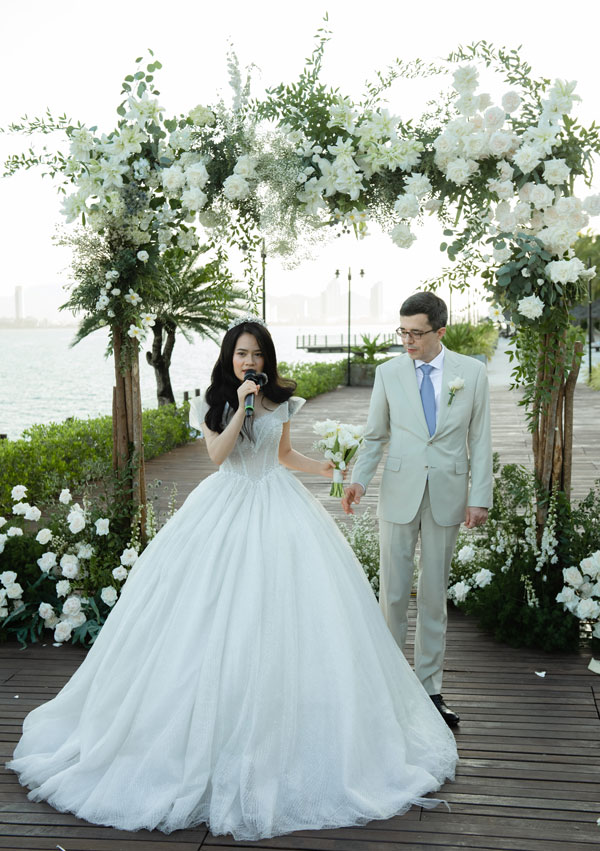
On the sand, the arch is the first thing guests see and the frame for every photograph of the vows. On a wooden pier, the couple stands over the water with nothing behind them but sky and sea. The space is narrow, so it suits a small group of family and close friends.
For a vow written in English, the couple can read their own words. A celebrant, microphone and speakers are supplied by Jolie Mai when you book them, and are quoted separately. The ceremony works best short: a few readings, the vows, the ring exchange, and then guests move to the shade or the dinner table.
Dinner by the water
After the vows, the same crew can set a long dinner table with candles and white flowers. In the photograph below, a long table with white flowers and glass lamps is set for a sunset dinner.
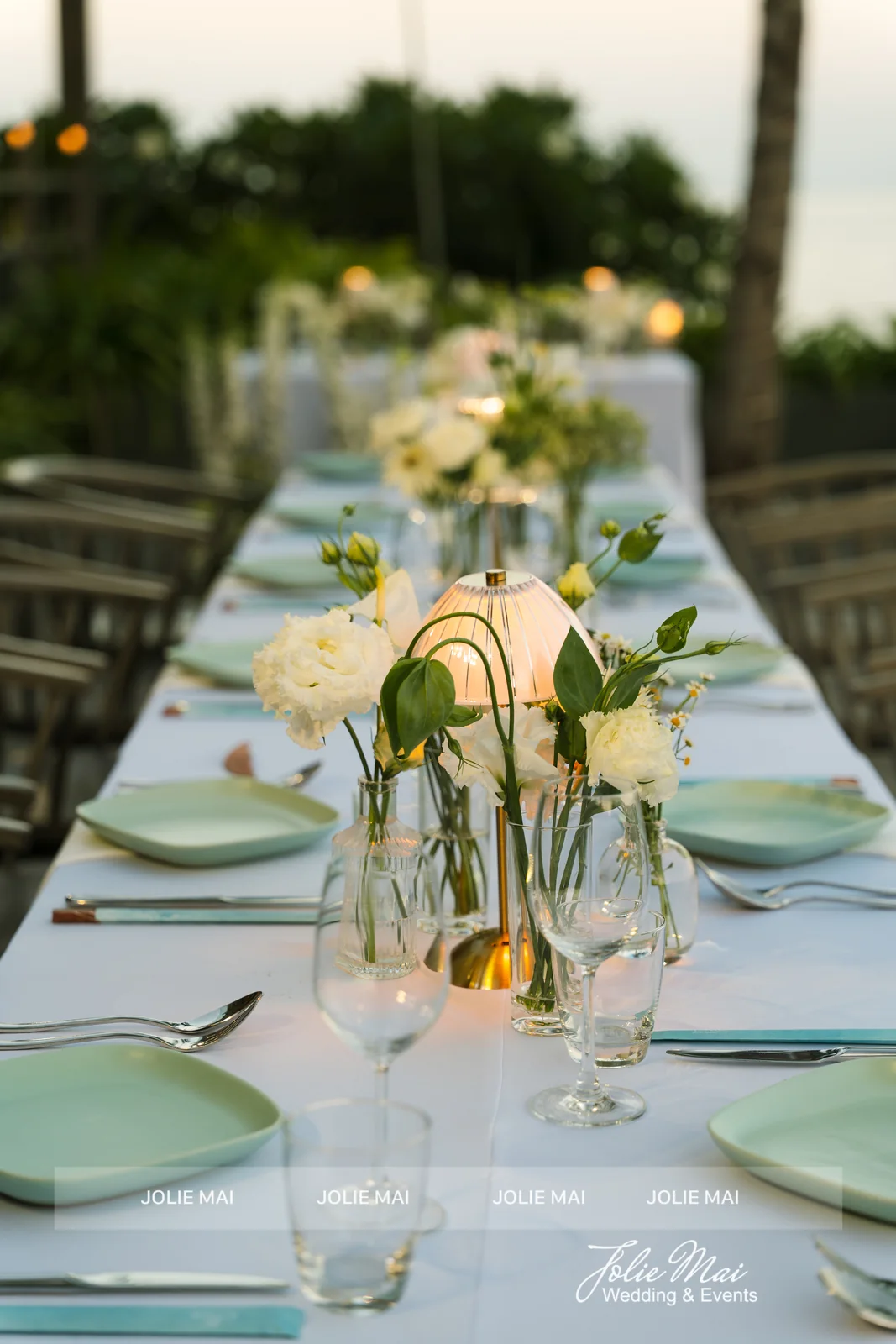
Our page on beach wedding in Nha Trang shows arch styles, ceremony layouts and sample dinners. Beach decoration and the Vietnamese tea ceremony are priced separately, so ask for each line in your quote.
How to plan a Vietnamese tea ceremony from abroad
If you live in the United States, Australia, Canada or Europe, you can plan most of the Vietnamese tea ceremony before you land. Here is an order that works.
- Talk to your parents first about the Vietnamese tea ceremony. Ask which rites they expect, which region’s customs they follow, and who will host. Write down what they say.
- Choose the place. A family home, a villa or a restaurant room each need a different decoration plan.
- Pick the style. Silk flowers or fresh, red and gold or soft pastel. Send Jolie Mai photographs of the room and any examples you like.
- Confirm the tray count and contents. Check this with the bride’s family, because they set the rule.
- Decide on outfits. Order áo dài early if they are tailored.
- Book and pay the deposit. The date is held once the VND 5,000,000 deposit is received.
- Approve the design plan. You see it in English, your parents see it in Vietnamese.
- Arrange the survey. Jolie Mai surveys the space before the date, at least seven days ahead of the ceremony.
Nobody expects parents and children to agree on everything. They expect to be asked.
Why couples choose Jolie Mai for a Vietnamese tea ceremony
The honest reasons come down to experience and language.
- Twelve years of decorating family ceremonies in Nha Trang, Khánh Hòa and Đà Lạt, including altar decoration, trays and the full-day sets described above.
- One team for the whole day: the altar, the trays, and, if you wish, the beach ceremony in the afternoon.
- Two languages in one team: English with you, Vietnamese with your parents.
- Prices written by item: Altar and trays are listed above, so you can compare before you write to anyone.
- Public reviews on Google Maps: you can read what other clients wrote about their ceremonies on the Jolie Mai Google Maps page.
The team has planned family ceremonies for local families and beach weddings for international guests, and the same method applies when you plan from abroad.
Frequently asked questions about the Vietnamese tea ceremony
What is a Vietnamese tea ceremony?
It is a family ritual in which the couple serves tea to their elders, lights incense at the family altar and receives the elders’ blessing. It often forms part of the engagement ceremony (lễ ăn hỏi) or the wedding morning (lễ vu quy). It is a cultural and family event, not a legal registration.
What to wear to a Vietnamese tea ceremony?
Áo dài is the traditional choice, with a khăn đóng for the bride and sometimes the groom. Men may also wear a suit. Guests can wear modest, smart clothes in red, gold, pink or ivory. Check colours with the families so photographs look unified.
How long does a Vietnamese tea ceremony take?
Allow a full morning: the rites, then photographs and a meal. A typical Vietnamese tea ceremony timeline fills the morning, so keep the afternoon light.
What is the Vietnamese tea ceremony timeline?
Typically: family gathers, the groom’s family arrives, trays are carried in, incense is lit at the altar, tea is served to the elders, group photographs follow, and a meal closes the morning. Exact hours are set by your families.
How much does a Vietnamese tea ceremony cost?
For the Jolie Mai part, a Diamond silk-flower altar is VND 9,800,000 and a traditional five-tray set is VND 4,700,000, together VND 14,500,000. A fresh-flower altar starts at VND 15,000,000. Food, clothing and photography are separate.
Do I need to speak Vietnamese to take part?
No. At the Vietnamese tea ceremony, Jolie Mai speaks English with you and Vietnamese with your parents, and an English-speaking host, booked as a separate service, can explain each step as it happens. Learning two or three phrases to greet the elders is welcome but not required.
Can my non-Vietnamese partner take part?
Yes. At a Vietnamese tea ceremony, many families are glad to include a partner from another background. Your partner can wear a suit, serve tea alongside you and learn a short greeting. Tell your parents beforehand so they can prepare.
Is the tea ceremony the same as the wedding?
No. It is one part of the Vietnamese wedding tradition and may be held on a separate day from the reception or the vow ceremony. Legal registration is a separate matter; check with your embassy or the local Department of Justice.
Can I hold a tea ceremony in the morning and a beach vow in the afternoon?
Yes, and it works well in Nha Trang because the two ceremonies need different light. Jolie Mai can decorate both; the beach part takes place on a private resort beach or deck, not the public Tran Phu beach.
How many trays do we need?
It depends on your regional custom. Northern families count an odd number such as 5, 7 or 9. Southern families count an even number such as 6 or 8. In Khánh Hòa, 5 trays is the most common request. Ask the bride’s family first.
Start planning your Vietnamese tea ceremony in Nha Trang
If your parents are waiting for a Vietnamese tea ceremony and you are still working out the details, a short message is the easiest place to start. Tell Jolie Mai the date you are considering, the place, and the region your family comes from, and you will receive a design plan in English that your parents can read in Vietnamese.
WhatsApp, Zalo or call +84 909 993 928, open 08:00 to 17:00 every day, or write to joliemaiwedding@gmail.com. The studio is at 85 – 89 Đường 23/10, Phường Tây Nha Trang, Khánh Hòa.


